
The new building has a roof in a speckled pattern of gold, green, and red-brown — calling to mind a type of trout that lives in the Grand River. It’s a symbol of how Indigenous thinking is rising to the forefront on many levels throughout Waterloo Region. Jean Becker, associate vice-president, Indigenous relations, at the University of Waterloo, stands beside an outdoor gathering space on campus. The space officially opens on Monday, which is National Day for Truth and Reconciliation.
(Photo by Mathew McCarthy, Waterloo Region Record)
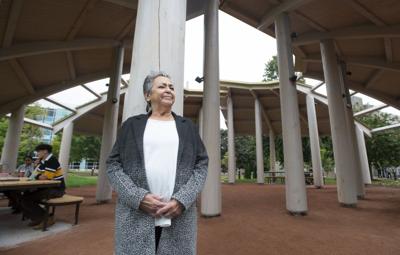
It’s a building unlike any other on campus.
It could not be more different from the boxlike concrete, glass and brick structures all around it at University of Waterloo. And that’s the whole point.
“When you walk around the university there’s so little indication of what this territory is,” said Jean Becker, associate vice-president Indigenous relations, at University of Waterloo.
“We are on the Haldimand Tract, and you would never know it from what you see around us.
“We felt it was really important to have a really visible space where Indigenous students, staff and faculty can see themselves in the space that they occupy. That was the reason we initiated the project.
“I hope it will become a really significant part of the landscape at Waterloo.”
The space will be open to both Indigenous and non-Indigenous members of the university. It will be used for ceremonial occasions, as an open-air classroom, and as a reminder to all about the Indigenous presence.
And it is a visible change as public institutions, such as universities, colleges, school boards and municipalities, have endeavoured to follow the recommendations of the Truth and Reconciliation Commission of Canada, after they were released in 2015.
The elevation of Indigenous professionals to senior management roles has led to real progress, Becker said.
“It’s made an enormous difference.”
Some of these differences have happened by creating an Indigenous presence in public spaces, some are services for Indigenous people, some are educational opportunities for all, and some involve profound ways in which thinking can be changed.
Recent developments include:
- Plans to establish an Indigenous-led child care service, on which the Region of Waterloo and the non-profit Indigenous organization, Healing of the Seven Generations, are working in partnership.
- A “wrapped” Grand River Transit bus will make its debut run Sept. 30, on the theme of “Every Child Matters.” The design on the bus is created by Judy Ross Mack, an Indigenous artist who lives in Waterloo.
- A wall display inside the Region of Waterloo building at 150 Frederick St., which shows greetings in Cree, Inuktitut, Mi’kmaq and Anishinaabmowin, among other Indigenous languages.
- Local municipalities honour occasions such as Red Dress Day (when murdered and missing Indigenous women are remembered), National Indigenous Peoples’ Day, and National Truth and Reconciliation Day.
- Local municipalities waive rental fees for First Nations, Métis and Inuit communities to host cultural and ceremonial events in city facilities.
- Staff at the City of Cambridge actively participate in a collaborative effort led by the City of Winnipeg’s Indigenous Relations Division. This group brings together municipalities to share knowledge, and learn and work together to promote reconciliation.
- The Region of Waterloo provided nearly $3 million in funding this year for projects led by organizations serving Indigenous, Black, and other equity-seeking groups. These funds have been offered since 2022 by the region’s Upstream Fund and Community Capacity Building Fund.
- The City of Kitchener has hired an Anishnaabe knowledge keeper and has partnered with local Indigenous organizations such as Crow Shield Lodge and White Owl Native Ancestry to create and lead programs specifically for Indigenous children and youth (as well as non-Indigenous children and youth) to help get them outside, on the land and to connect them to culture. Fees for Indigenous families are waived.
- Conestoga College recently hosted a symposium to share information about Indigenous approaches to education, to encourage teachers to find ways to integrate these approaches into their classrooms.
- At the college and local universities, Indigenous education is also being built in a variety of ways. University of Waterloo now offers a minor in Indigenous Studies and both universities do their best to create a “home away from home” for Indigenous students.
It also means rethinking traditional curriculum, such as including information on entrepreneurship on reserves as part of a business course, or integrating scientific knowledge to include Indigenous findings.
Non-Indigenous people may see Indigenous knowledge as being closer to folklore than science. But that’s a false belief, says Darren Thomas, associate vice-president Indigenous Initiatives at Wilfrid Laurier University.
When it came to understanding how plants can be used as medicine, for example, “we went through a very similar empirical process” of trial and error as someone in a lab would, he said.
“We have profound ways of knowing.”
Even the concept of a land acknowledgment, which has come into wide use, may have to be rethought, says Brian Hill, the City of Waterloo’s reconciliation, equity, accessibility, diversity and inclusion Indigenous initiatives advocate.
It is sometimes interpreted by non-Indigenous people that they are on Indigenous land, and their view of that land may be focused on “defining who owns it,” he said.
“The Indigenous view is we don’t own it, we’re just part of it, and we take care of it while we’re in this space.”
And another non-Indigenous idea is thinking about reconciliation as a checklist of accomplishments and goals, he added.
“Reconciliation is not a checklist,” he said.
“There’s not a finish line to this. There’s a better understanding happening through engagement with the Indigenous communities.”